Japan is often seen as a paradise for anglers. It is the birthplace of Shimano and Daiwa, and the home of high-precision JDM (Japanese Domestic Market) tackle.
Many international anglers assume: “Since I can buy the world’s best gear here, I can fish anywhere, right?”
This is a fatal error.
While Japan does not have a strict “Saltwater License System” like the US or Europe, its waters are governed by a complex, invisible logic known as “Fishery Rights” and strictly enforced zoning laws. Ignoring these is not just “rude”—it can lead to police involvement and the confiscation of your expensive tackle.
At RIVOSEA, we believe that understanding the “Laws of Society” is just as important as understanding the “Laws of Physics” in fishing. Before you cast your line, you must understand the system of the Japanese field.
1. Do You Need a Fishing License?
The answer depends entirely on Salinity.
Saltwater (Ocean/Bay/Surf)
Basically: NO. Unlike in California or Australia, you generally do not need to purchase a license to fish in the ocean from the shore (embankments, beaches, rocky shores). Access is free in most public areas.
The Logic: In Japan, the ocean is historically considered a “commons” managed by local communities, rather than a state-owned resource requiring individual taxation (licenses).
Freshwater (River/Lake)
Absolutely: YES. If you fish in a river or lake (for Trout, Bass, Ayu, etc.), you MUST purchase a “Recreational Fishing Ticket” (Yu-gyo-ken). These are sold at local convenience stores or bait shops near the river.
Warning: River rangers patrol frequently. If caught without a ticket, you will pay a heavy fine.
2. The Invisible Barrier: “Fishery Rights” (Gyogyoken)
Even though the ocean is free to fish, it is NOT free to harvest. This is where the concept of “Gyogyoken” (Fishery Rights) comes in.
Local Fishery Cooperatives have the exclusive legal right to harvest specific marine life in their area. As a recreational angler, you are strictly prohibited from taking:
Abalone (Awabi)
Spiny Lobster (Ise-ebi)
Sea Urchin (Uni)
Seaweed (Wakame/Kombu)
Sea Cucumber (Namako)
This is the Logic: Catching a fish with a rod is “Sport.” Taking a shellfish from the rock is “Theft.” If you take these, it is considered Poaching (Criminal Offense). Police in coastal towns are very sensitive to this. Never touch them, even if you find them easily in shallow water.
3. Decoding the “Kanji” Signs (Survival Data)
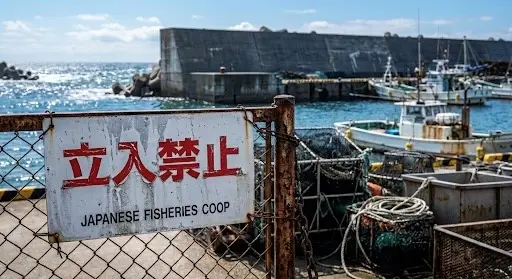
The biggest challenge for international anglers is the language barrier. Japanese ports are full of warning signs. Ignoring them because “I can’t read Kanji” is not a valid defense.
Here are the two most critical signs you must memorize to identify the Physical and Legal Safety Zones.
Sign A: “Tachi-iri Kinshi” (立入禁止)
Meaning:KEEP OUT / NO ENTRY
The Logic: This area is legally off-limits. It might be due to dangerous waves, crumbling infrastructure, or SOLAS (Safety of Life at Sea) treaties regarding anti-terrorism laws at ports.
Action:Do not enter under any circumstances. Jumping a fence here is illegal trespassing.
If you see these four characters “立入禁止”, turn back immediately.
Sign B: “Tsuri Kinshi” (釣り禁止)
Meaning:NO FISHING
The Logic: You may walk here, but you cannot fish. This is often because casting lines interferes with fishing boats or harbor workers.
Action: Pack up your gear and move to another spot.
Pro Tip: If you are unsure, use Google Lens on your smartphone to translate the sign in real-time. Verify the data before you act.
4. The “Silence” Protocol (Local Etiquette)
In Japan, fishing ports are primarily workplaces for fishermen, not parks for tourists. The relationship between anglers and fishermen is delicate.
To survive in this environment, follow these logical protocols:
Greetings (Aisatsu): If you see a local fisherman, simply say “Ohayo-gozaimasu“ (Good Morning) or “Konnichiwa“ (Hello). This simple data exchange signals that you are not a hostile intruder.
Clean Up: Japanese culture operates on strict “collective responsibility.” If one angler leaves trash (line, hooks, cans), the entire port may be closed to fishing the next day. Logic:Trash = Port Closure. To keep fishing, you must take your trash home.
Conclusion
Japan offers a unique and exciting fishing environment, but it operates on a strict set of unwritten rules and legal frameworks.
Saltwater: No license, but respect the Fishery Rights.
Signs: “立入禁止” means Stop.
Behavior: Silence, Respect, and Cleanliness.
By following these rules, you earn the respect of the locals and the right to enjoy this field. Now that you understand the “Software” (Rules) of Japanese fishing, you are ready for the “Hardware.”

Comments