
You see them on the sonar. A massive school of Kingfish (Hiramasa) or Amberjack. You drop your jig, and you start reeling like a maniac. Your arm is burning, your heart is pounding, but the rod tip never bends.
You think: “I wasn’t fast enough.”
Wrong. You were too predictable.
In the West, “Speed Jigging” is often synonymous with “high-speed retrieve.” But in Japan, we know that speed alone does not trigger the biggest predators. The true secret lies in the “Gap” (Ma / 間).
The Predator’s Logic: Why Speed Fails
Imagine a cat chasing a laser pointer. If you move the laser in a perfect circle at a constant speed, the cat eventually loses interest. It becomes “background noise.”
But what if you move it fast, then suddenly stop? The cat pounces.
The “Reaction Bite” Mechanism
- Constant Speed: The fish follows, observes, and decides “It’s not worth the energy.”
- The Jerk (Chaos): The jig darts sideways, mimicking a panicked baitfish. The predator’s switch turns on.
- The Pause (Opportunity): The jig hangs weightless for a split second. This is when 90% of strikes happen.
If you are just reeling fast without rhythm, you are denying the fish the “opportunity moment” to bite.
The Japanese Standard: “One Pitch Jerk”
The foundation of JDM (Japanese Domestic Market) jigging is the One Pitch Jerk. It is not about brute strength; it is about rhythm and physics.
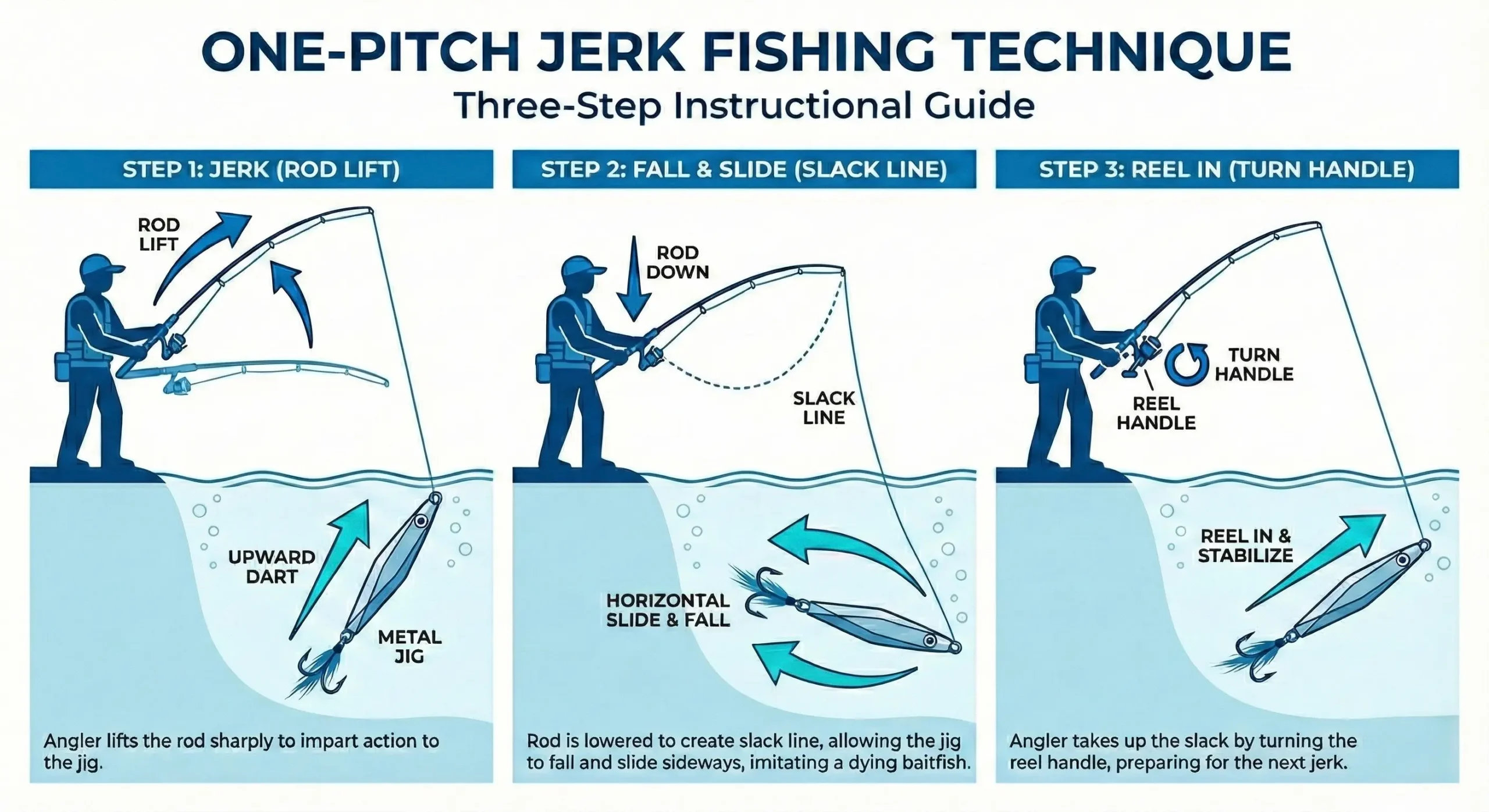
How to Execute
-
1.
The Lift: Lift the rod tip sharply (Jerk). This accelerates the jig upward. -
2.
The Slack: Immediately lower the rod tip while winding the handle exactly one turn. -
3.
The Glide: This creates momentary “slack.” The jig slides sideways instead of falling. This is the kill zone.
Strategy by Target
Not all predators react to the same rhythm. You must adjust your pitch based on the target.
VS Kingfish (Hiramasa)
Kingfish have incredible vision. They will spot a fake if it moves too mechanically.
- Key: Long Slide.
- Use a longer, softer rod stroke to make the jig slide wide. Give them time to chase and intercept the “fleeing” bait.
VS Amberjack (Kanpachi)
Amberjack are torque monsters that hunt near the bottom structure.
- Key: The Fall.
- They often bite when the jig is falling. Pitch up, then let the jig flutter down for a second. They strike on the drop.
Hayato’s Protocol: The “Variable Rhythm”
Once you master the basic rhythm, you must learn to break it.
“Fish are smart. If you do the same ‘One Pitch’ for 100 meters, they will learn the pattern. My favorite combo? 5 fast cranks (to get their attention) -> followed by 3 slow, wide One Pitch Jerks (to show the slide). Make them chase, then give them the kill shot.”
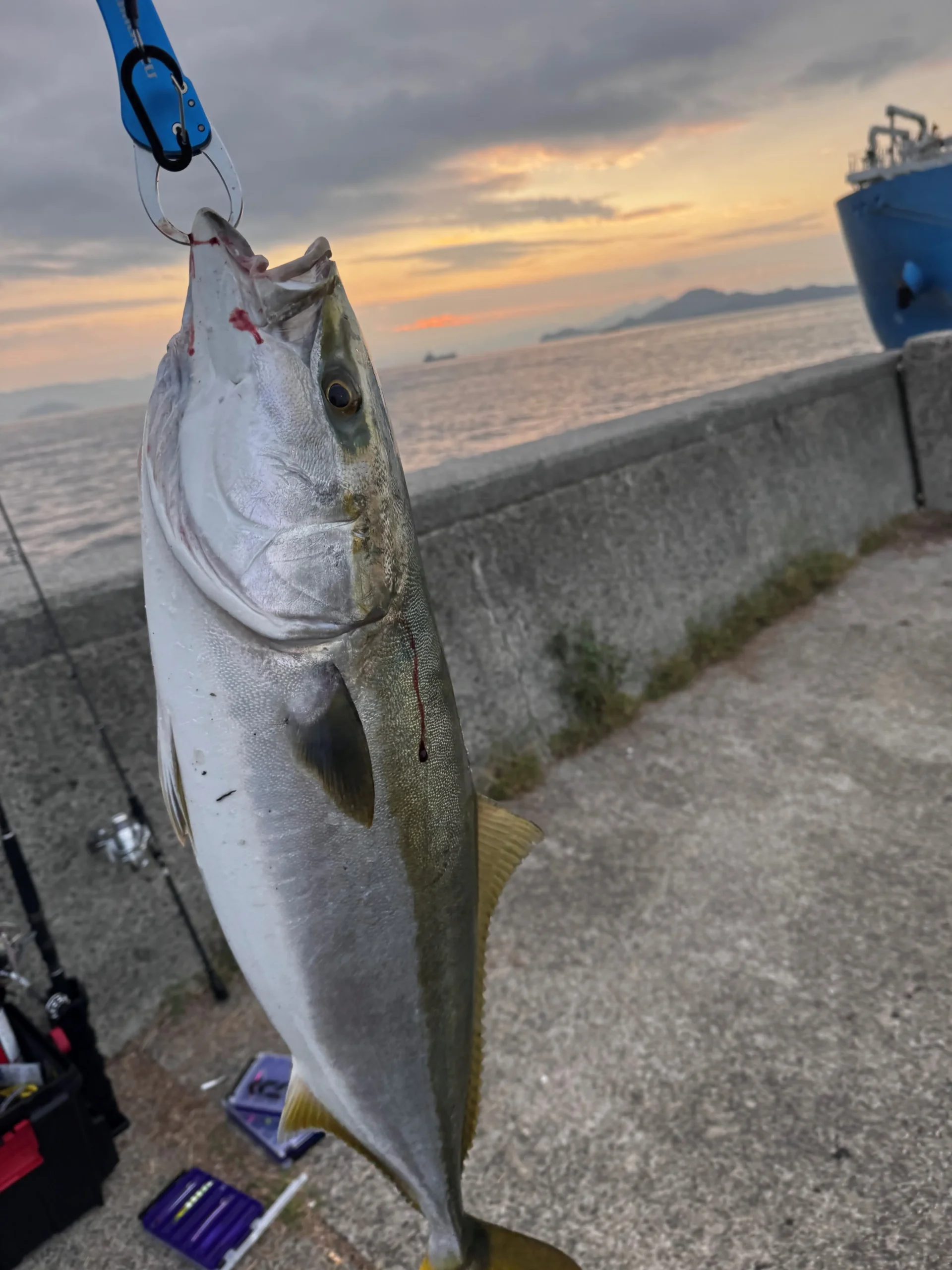
Conclusion: Control the Chaos
Stop fighting the ocean with brute force. Use physics. Use the rod’s elasticity to fly the jig, and use the slack line to let it dance.
When you stop simply “reeling fast” and start “conducting the jig,” the Kingfish will respond.
RIVOSEA TECHNIQUE RATING
“Essential for High-Pressure Waters”
The Universal Killer (Most Effective)
🌎 Global stock & secure shipping
*Affiliate link. We may earn a commission.
Comments